
Blog
German Pancake Recipe (Puffy Oven Dutch Baby in Cast Iron)

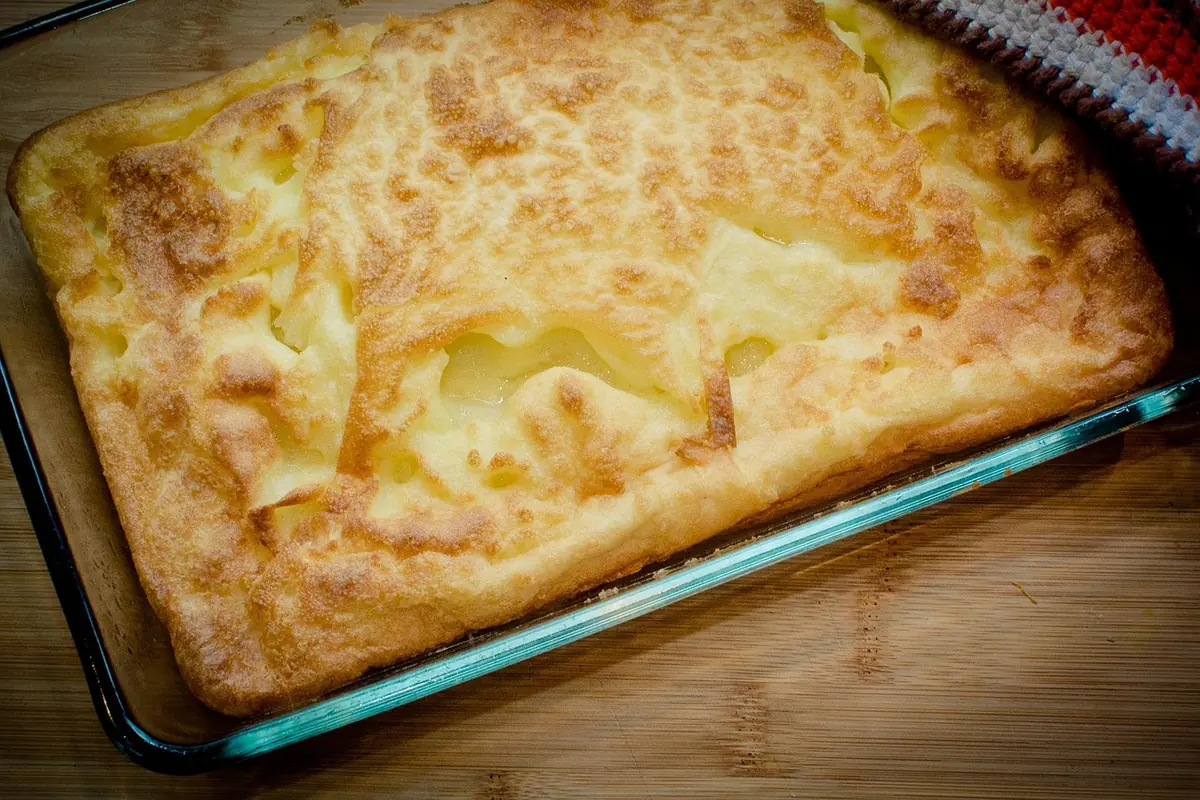
This German pancake recipe turns 3 eggs, ½ cup of flour and ½ cup of milk into a tall, golden pancake that puffs up the sides of a hot cast iron skillet like a crown. It bakes in the oven in about 20 minutes, needs no flipping and no standing at the stove, and comes out crisp at the edges and soft and custardy in the middle.
You may know it as a Dutch baby, a German puff pancake or an oven pancake. They’re all the same simple batter. Below you’ll find the method, blender and whisk options, why it puffs and why it sinks, a scaling chart for bigger pans and muffin tins, sweet and savory toppings, a troubleshooting table and a printable recipe card for one 10-inch pancake that serves 2 to 3.
German Pancake Recipe at a Glance
Here’s the whole idea in six steps.
- Heat the oven to 425°F (220°C) with a 10-inch cast iron skillet inside.
- Make the batter: blend or whisk 3 room-temperature eggs, ½ cup (63 g) flour, ½ cup (120 ml) milk, a little sugar, vanilla and salt until smooth.
- Melt the butter: add 3 tablespoons of butter to the hot skillet and swirl until it foams.
- Pour and bake: pour the batter into the center of the sizzling butter and bake 18 to 22 minutes without opening the door.
- Check it: it’s done when the sides are tall and deep golden brown and the center is set.
- Serve right away with lemon juice and powdered sugar, or the topping of your choice.
What Is a German Pancake (Dutch Baby)?
A German pancake is a large, eggy pancake baked in a very hot pan in the oven. The batter is thin, close to a crepe batter, and it has a high ratio of eggs to flour. In the heat, the edges climb the sides of the pan and puff into crisp, uneven peaks, while the center stays low, tender and slightly custardy.
The name “Dutch baby” is usually traced to a Seattle restaurant in the early 1900s; “Dutch” likely comes from “Deutsch,” meaning German. Here’s how it compares to its relatives:
- Dutch baby vs. American pancakes: fluffy pancakes use baking powder and a thick batter cooked on a griddle. A Dutch baby has no leavening at all; steam and eggs do the lifting.
- vs. Yorkshire pudding: nearly the same batter, but Yorkshire puddings are baked in hot beef drippings and served with a roast.
- vs. clafoutis: a French baked batter with fruit, sweeter and denser, more like a custard than a puffy pancake.
If you love a stack of griddle pancakes too, browse our easy pancake recipe ideas for five more ways to start the morning.
Ingredients and Why Each One Matters
You likely have everything already. The amounts are small, so measure carefully; a little extra flour is the most common reason a pancake bakes up flat and bready instead of tall and airy.
| Ingredient | Amount | What it does |
|---|---|---|
| Large eggs, room temperature | 3 | The structure. Egg proteins set around the steam bubbles and hold the puff. |
| All-purpose flour | ½ cup (63 g) | Adds body and helps the edges crisp. Spoon it into the cup and level it. |
| Whole milk, room temperature | ½ cup (120 ml) | The water in milk turns to steam, which lifts the batter. Whole milk browns best. |
| Granulated sugar | 1 tablespoon (12 g) | A hint of sweetness and better browning. Leave it out for savory versions. |
| Vanilla extract | ½ teaspoon | Warm flavor. A pinch of nutmeg is a classic extra. |
| Fine salt | ¼ teaspoon | Keeps it from tasting flat. |
| Unsalted butter | 3 tablespoons (42 g) | Greases the pan, fries the edges and gives the pancake its buttery flavor. |
Low-fat milk works but browns a little less. For dairy-free, use unsweetened oat milk and a plant butter.
The Right Pan and Tools
The pan matters more than any other piece of equipment here. It has to be oven-safe at 425°F (220°C), and it should hold heat well, so the batter starts cooking the moment it lands.
- 10-inch cast iron skillet (best): it stores lots of heat, gives the tallest rise and the crispest edges, and goes straight to the table.
- Oven-safe stainless steel or carbon steel skillet: works almost as well; butter generously so it releases.
- Glass or ceramic baking dish: usable, but don’t heat an empty glass dish. Melt the butter in it as the oven heats instead, and expect a slightly lower puff.
How to Make a German Pancake, Step by Step
The method is simple, but the details give you a dramatic rise.
1. Warm the ingredients
Set the eggs and milk out for 30 to 60 minutes. In a hurry? Put the whole eggs in a bowl of warm tap water for 5 to 10 minutes, and microwave the milk for 20 to 30 seconds until it’s just lukewarm, not hot. Cold batter cools the pan and slows the steam, which means a shorter puff.
2. Heat the oven and the skillet together
- Place a rack in the center of the oven, with no rack directly above it, since the pancake can rise 3 inches or more.
- Set the empty cast iron skillet on the rack and heat the oven to 425°F (220°C).
- Let the skillet heat for at least 10 minutes after the oven reaches temperature.
3. Make the batter
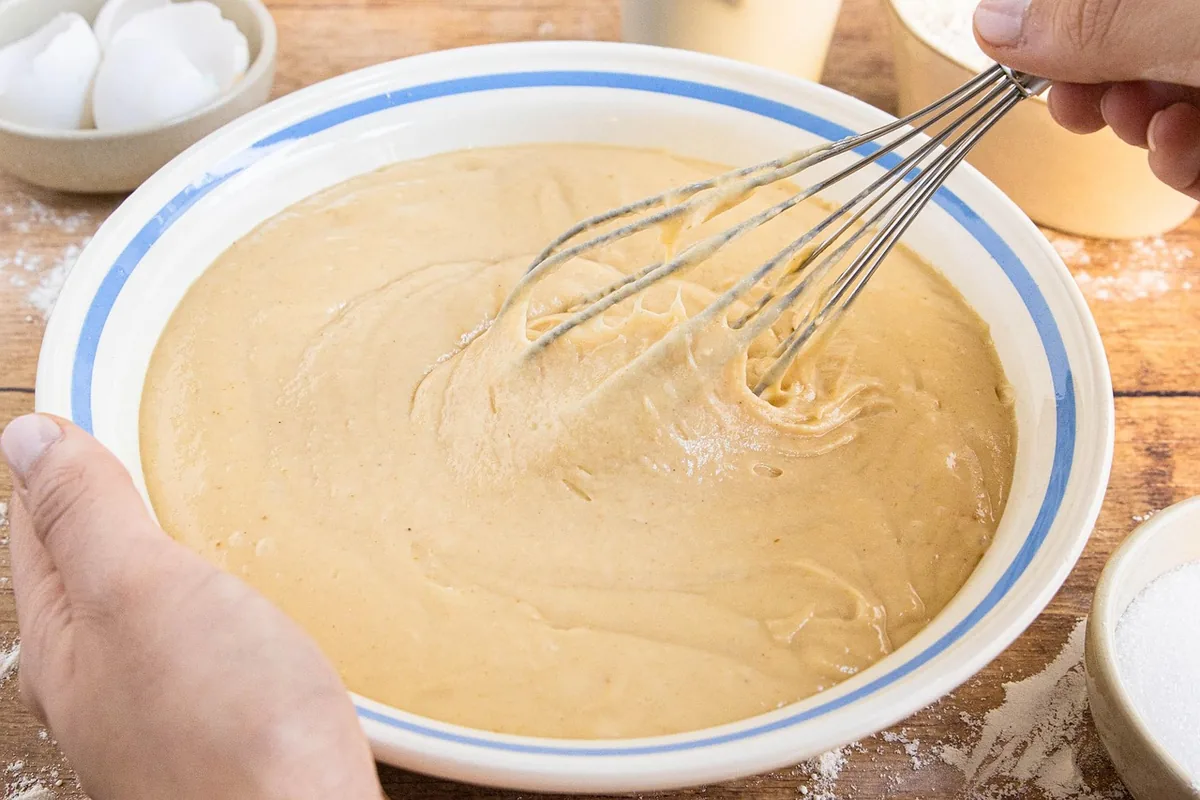
Add the eggs, flour, milk, sugar, vanilla and salt to a blender and blend for 20 to 30 seconds until completely smooth and a little frothy. If you’re whisking by hand, beat the eggs first, then whisk in the flour, sugar and salt, and finally the milk and vanilla. Whisk for a full minute until no lumps remain.
Let the batter rest while the skillet finishes heating; even 10 minutes makes it more tender.
4. Melt the butter in the hot pan
Pull the skillet out with oven mitts, add the butter and swirl it around the bottom and up the sides. It should melt in seconds and foam. Light brown butter is fine; black flecks are not.
5. Pour and bake
- Give the batter a quick stir or pulse, then pour it straight into the center of the sizzling butter. Don’t stir it.
- Return the skillet to the oven right away.
- Bake 18 to 22 minutes, until the sides are tall, puffed and deep golden brown and the center is set.
- Don’t open the door for the first 15 minutes. A rush of cool air can make it fall early.
6. Serve immediately
Carry the skillet to the table, squeeze lemon over the top, dust with powdered sugar and cut into wedges. The puff starts to settle within a minute or two. That’s expected, and it doesn’t change the flavor at all.
Blender or Whisk: Which Is Better?
Both work. The goal is a smooth batter with no lumps of flour and a little air. Pick whichever tool is easier to clean in your kitchen.
| Method | How long | Result | Good to know |
|---|---|---|---|
| Blender | 20 to 30 seconds | Very smooth, slightly frothy batter; often the tallest, most even puff | Fastest. Pour straight from the jar into the pan. |
| Hand whisk | About 1 minute | Smooth if you whisk eggs and flour first, then add milk | No machine needed. Tiny lumps are fine; big ones are not. |
Don’t worry about overmixing; with so little flour, the batter won’t turn tough.
Why It Puffs and Why It Falls
There’s no baking powder or yeast in a Dutch baby, so the rise is pure kitchen science. Understanding it makes the recipe nearly foolproof.
- Steam does the lifting. The batter is mostly liquid. When it hits a pan that’s well over 400°F, the water in the milk and eggs flashes into steam and pushes the batter up and outward.
- Eggs build the walls. As the steam expands, egg proteins set around the bubbles and form a crisp shell. That’s why this batter has three eggs for only half a cup of flour.
- Heat from below starts it fast. A hot skillet sets the bottom instantly, so the edges have something to climb on. A cold pan gives you a flat, eggy pancake.
So why does it fall? Once it leaves the oven, the steam inside cools and turns back into water, and the walls settle. Every Dutch baby does this within a few minutes, so a sinking pancake is a sign that you made it correctly, not a mistake.
Pan Sizes and Scaling Your German Pancake Recipe
The basic ratio is easy to remember: 1 egg to about 2½ tablespoons each of flour and milk. Scale it up for a bigger pan or a crowd, or down for single portions. Times are for 425°F (220°C) unless noted.
| Pan | Eggs | Flour | Milk | Butter | Bake time | Serves |
|---|---|---|---|---|---|---|
| 8-inch skillet | 2 | ⅓ cup (42 g) | ⅓ cup (80 ml) | 2 tbsp | 15 to 18 min | 1 to 2 |
| 10-inch skillet (recipe card) | 3 | ½ cup (63 g) | ½ cup (120 ml) | 3 tbsp | 18 to 22 min | 2 to 3 |
| 12-inch skillet | 4 | ⅔ cup (83 g) | ⅔ cup (160 ml) | 4 tbsp | 20 to 24 min | 3 to 4 |
| 9×13-inch metal pan | 6 | 1 cup (125 g) | 1 cup (240 ml) | 6 tbsp | 20 to 25 min | 5 to 6 |
| 12-cup standard muffin tin | 3 | ½ cup (63 g) | ½ cup (120 ml) | 1 tsp per cup | 12 to 15 min | 12 minis |
| 24-cup mini muffin tin | 3 | ½ cup (63 g) | ½ cup (120 ml) | ½ tsp per cup | 8 to 11 min | 24 bites |
Tips for the 9×13 pan
The 9×13 version is the one to make for a holiday brunch. Use a metal pan if you have one. With a glass dish, put the butter in the cold dish, let it melt as the oven heats, and add 2 to 4 minutes to the bake time.
Tips for muffin-tin minis
- Heat the tin in the oven for 5 minutes, add the butter to each cup, then return it for 1 to 2 minutes until it’s sizzling.
- Fill each cup about halfway, no more, so the minis have room to rise.
Toppings: Sweet and Savory
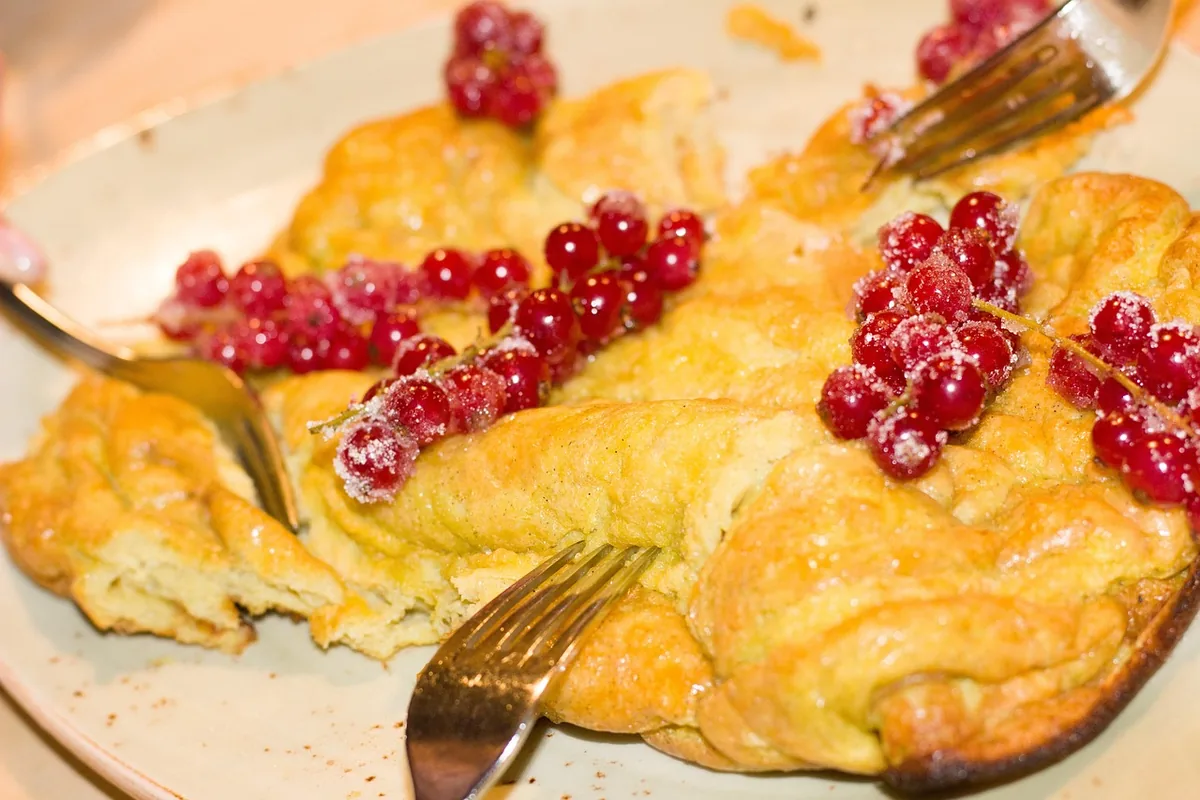
The classic way to serve a German pancake is the simplest: a squeeze of fresh lemon and a heavy snowfall of powdered sugar. The tart juice soaks into the soft center and the sugar melts into a light glaze. From there, change it up with the season.
- Lemon and powdered sugar: half a lemon and 1 tablespoon of powdered sugar per pancake.
- Fresh berries: a cup of sliced strawberries, blueberries or raspberries piled into the center, with a spoonful of whipped cream or Greek yogurt.
- Syrups and spreads: warm maple syrup, honey, jam, lemon curd or a thin drizzle of chocolate-hazelnut spread.
- Savory ham and cheese: see the version below.
Sautéed apple German pancake
This variation tastes like apple pie for breakfast. The apples cook in the skillet first and the batter bakes right around them.
- Heat the oven to 425°F (220°C). Peel, core and thinly slice 1 large apple, such as Honeycrisp or Granny Smith.
- In the 10-inch cast iron skillet, melt the 3 tablespoons of butter on the stove over medium heat. Add the apple, 1 tablespoon brown sugar and ½ teaspoon cinnamon.
- Cook, stirring, for 4 to 5 minutes until the apples are just tender and glossy. Spread them in an even layer.
- Pour the batter over the hot apples and bake 20 to 24 minutes. The edges puff a little less than the plain version, and that’s fine.
Savory ham and cheese Dutch baby
Leave the sugar and vanilla out of the batter and add ¼ teaspoon black pepper and 1 tablespoon chopped chives. Scatter ½ cup (70 g) diced cooked ham into the melted butter, pour the batter over and bake. In the last 3 to 4 minutes, sprinkle ½ cup (55 g) shredded Gruyère or sharp cheddar over the center. For another savory breakfast with a creamy sauce, try our chipped beef on toast.
Troubleshooting a German Pancake
When a Dutch baby doesn’t turn out right, the cause is almost always temperature or measuring.
| Problem | Likely cause | Fix |
|---|---|---|
| Didn’t puff | Pan not hot enough, cold batter, or the oven door opened early | Heat the skillet in the oven at least 10 minutes past preheat, use room-temperature eggs and milk, and keep the door shut for 15 minutes. |
| Tastes eggy | Underbaked center, or a skimpy measure of flour | Bake until deep golden, not pale. Add the vanilla, a pinch of nutmeg and the full ¼ teaspoon of salt. |
| Soggy or wet middle | Pulled too soon, a too-small pan, or heavy wet toppings added before baking | Bake 2 to 4 minutes longer, use the right pan size, and add fruit after baking (except the sautéed apples). |
| Stuck to the pan | Too little butter, butter not melted and hot, or a poorly seasoned skillet | Use the full 3 tablespoons, swirl it up the sides and pour the batter only once it foams. |
| Dense and bready | Too much flour | Spoon flour into the cup and level it, or weigh 63 g. |
Egg and Flour Safety
A German pancake is mostly eggs, so it needs to bake through. Fortunately, the high oven heat makes that easy.
- Bake until set and puffed. The edges should be tall and golden and the center should look set, not wet or shiny. Egg dishes are safe at 160°F (71°C), per the FoodSafety.gov safe minimum internal temperatures chart; an instant-read thermometer in the center of the thickest part will tell you if you’re unsure.
- Don’t taste the raw batter. Raw eggs can carry Salmonella, and raw flour isn’t a ready-to-eat food either. The FDA explains why in its guide to handling flour safely.
- Mind the handle. A cast iron handle stays dangerously hot for a long time. Drape a towel or mitt over it the moment it leaves the oven.
Serving, Make-Ahead and Storage
A Dutch baby is at its best in the first five minutes, so have the toppings ready before it comes out. One 10-inch pancake makes 2 generous or 3 lighter servings.
- Sides: crispy bacon or breakfast sausage, scrambled eggs, a fruit salad and coffee.
- For a crowd: this German pancakes recipe scales to a 9×13 pan; see the chart. Our easy waffle recipe ideas round out a big brunch spread.
- Make ahead: blend the batter the night before and refrigerate it, covered, for up to 24 hours. Let it sit at room temperature 30 minutes, or warm the jar in warm water, then stir before pouring.
- Dessert: a German pancake with sautéed apples and a scoop of vanilla ice cream makes a quick dessert. For other easy sweet bakes, try our honey bun cake or a batch of mini cheesecakes, or browse all our breakfast recipes.
Refrigerate leftovers within 2 hours in an airtight container and eat them within 3 to 4 days, following the cold food storage chart. Reheat wedges in a 350°F (175°C) oven or toaster oven for 5 to 7 minutes to bring back some crispness.
German Pancake Recipe FAQ
What is the difference between a German pancake and a Dutch baby?
There’s no real difference. A Dutch baby is the American name for a German-style oven pancake. Some cooks call the larger 9×13 version a German pancake and the skillet version a Dutch baby, but the batter is the same.
Why didn’t my German pancake puff up?
The pan or the batter wasn’t warm enough. Heat the empty skillet in a 425°F (220°C) oven for at least 10 minutes past preheat, use room-temperature eggs and milk, and don’t open the oven for the first 15 minutes.
Is a German pancake supposed to fall?
Yes. The puff is held up by steam, and it settles within a few minutes of leaving the oven. The edges stay crisp and the center stays tender.
How do you know when a Dutch baby is done?
The sides are tall and deep golden brown, the edges look crisp and the center is set with no wet batter. In a 10-inch skillet at 425°F, that’s usually 18 to 22 minutes.
German Pancake Recipe Card
Calories are an estimate per serving (one third of a 10-inch pancake) based on USDA FoodData Central values for whole eggs, all-purpose flour, whole milk, butter, sugar, vanilla, powdered sugar and lemon juice. Berries and other toppings are extra.

German Pancake (Dutch Baby)
Ingredients
Equipment
Method
- Set a rack in the center of the oven with no rack above it. Put the empty 10-inch cast iron skillet on the rack and heat the oven to 425°F (220°C). Let the skillet heat at least 10 minutes after the oven is hot.
- Blend the eggs, flour, milk, sugar, vanilla and salt for 20 to 30 seconds until smooth and frothy, or whisk the eggs, then the flour, sugar and salt, then the milk and vanilla for about 1 minute until no lumps remain. Let the batter rest while the skillet heats.
- Take the skillet out with oven mitts, add the butter and swirl it over the bottom and up the sides until it melts and foams.
- Stir the batter once and pour it into the center of the sizzling butter. Return the skillet to the oven right away.
- Bake 18 to 22 minutes without opening the door for the first 15 minutes, until the sides are tall, puffed and deep golden brown and the center is set with no wet batter.
- Squeeze lemon over the pancake, dust with powdered sugar, add berries if you like and cut into wedges. Serve right away; it will settle as it cools.


